
HealthAI Documents on AI Governance in Health
Reports, publications, and other materials exploring the latest challenges and opportunities in responsible AI in health.
Documents
Show All Tags
HARNESSING AI FOR HEALTH AND ECONOMIC COMPETITIVENESS: Translating the EU AI Act into Action
This report examines how the European Union's policy strategies, regulatory frameworks and national implementation intersect when it comes to artificial intelligence in the health sector.
AI GOVERNANCE IN HEALTH Global Landscape 2025 Report
A comprehensive analysis of the current AI governance in health landscape
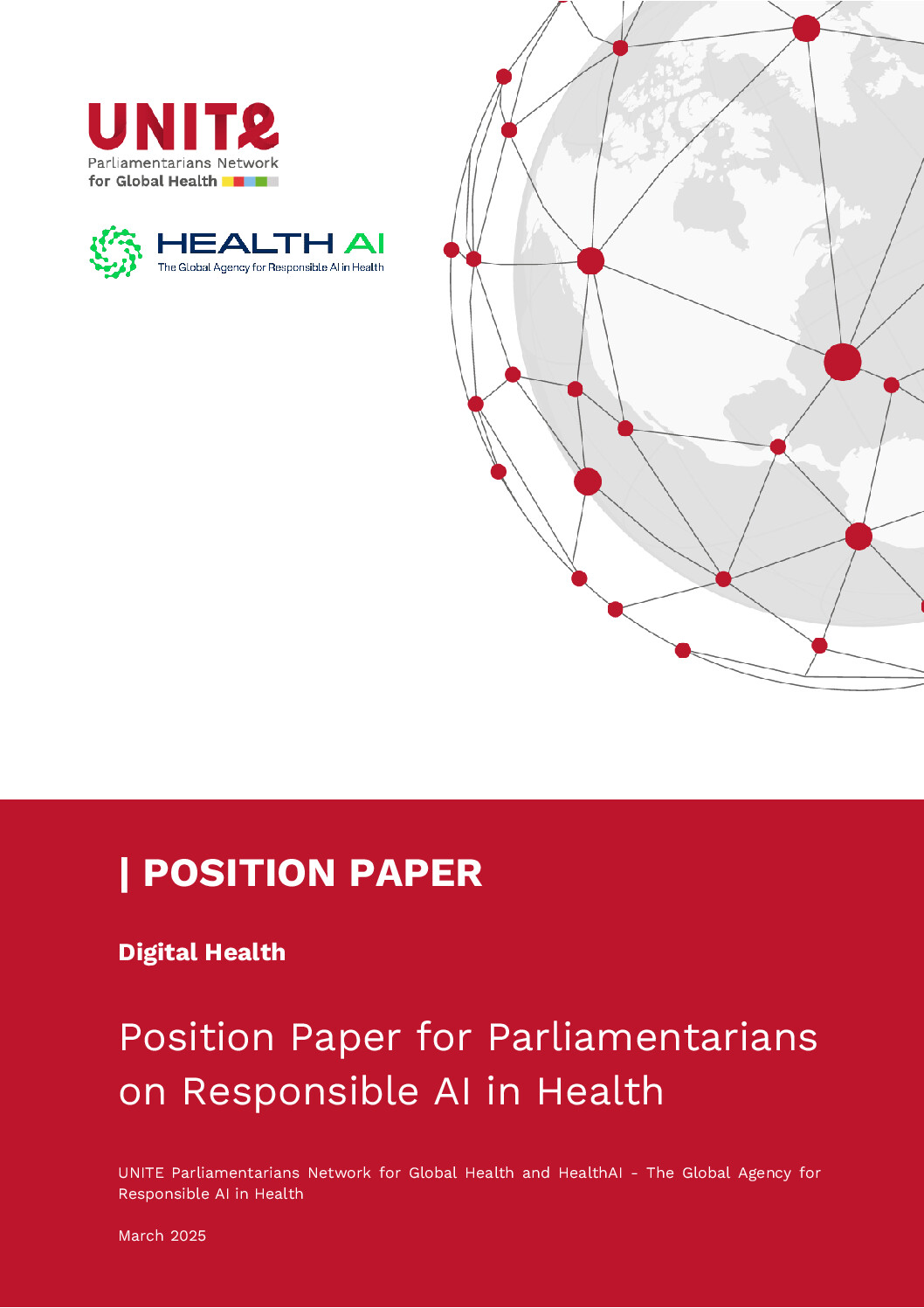
UNITE and HealthAI Position Paper for Parliamentarians
AI has the potential to revolutionize healthcare, but thoughtful governance is essential. UNITE and HealthAI released their position paper, emphasizing the crucial role of parliamentarians in guiding the responsible use of AI in health.
Mapping AI Governance in Health From Global Regulatory Alignments to LMICs’ Policy Developments
Mapping AI Governance in Health: From Global Regulatory Alignments to LMICs’ Policy Developments. A report authored by Dr. Peiling Yap and Dr. Laura Arbelaez Ossa.
Global Research Map of Digital Health (2021 Report)
The GRM report provides visibility and understanding of current research and investment trends in the Digital Health and AI for health fields, along with an evaluation of the National Digital Health Strategies (NDHS) of 23 countries.
Aligning AI Governance Globally
Amandeep Singh Gill describes how a holistic commons approach, shared vocabulary and values and digital public infrastructures could be powerful ways to better align the governance of AI globally and unleash its potential.
Curated Resources on AI Governance in Health
Valuable resources on AI governance in health from partner organizations, renowned academic institutes, and think tanks dedicated to this topic.

OECD: Proceeding report from Madrid conference on the responsible scale of AI in healthcare
AI applications are increasing in scope, spanning clinical decision support, diagnostics, public health system management, as well as administrative and operational functions such as medical scribes, and other areas. Given the rapid deployment of AI and its demonstrated advantages for specific tasks, the question is no longer “should we adopt AI in health?”, but “how do we adopt AI effectively and safely?”
Building Cross-Border Bridges to Scale Health Innovation: Addressing Regulatory Fragmentation for African Innovators
Africa is producing some of the world’s most contextually grounded health innovations. AI-powered diagnostic tools, drone-enabled last-mile delivery, and mobile platforms are already reaching communities that formal health systems have long underserved. Yet most of these tools remain trapped within national borders.
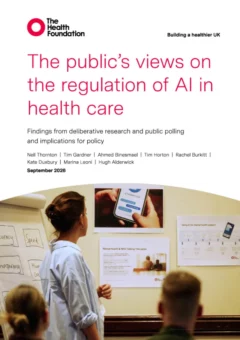
The Health Foundation: The public’s views on the regulation of AI in health care
Commissioned as the research partner to the MHRA's independent National Commission into the Regulation of AI in Healthcare, this report brings together findings from an annual polling of public attitudes towards AI with new findings from a UK-wide public deliberative exercise exploring what the public thinks regulators should prioritise and what is needed to build and maintain public trust in AI regulation.
Medical Protection – Closing the AI Liability Gap: AI, Safety, and the Case for Legislative Change
As AI use grows in clinical practice, the law has not kept pace. "Closing the AI Liability Gap: AI, safety, and the case for legislative change" highlights gaps in UK product liability law. In particular, when using AI recommender systems there is potential for clinicians to be unfairly exposed to clinical negligence claims in instances when AI outputs go wrong.
Nature: The AI4GH community of practice: strengthening LMIC-Led artificial intelligence for global health
Efforts to research, implement and scale responsible AI for addressing health challenges in LMICs are often fragmented. It limits collaboration and slows progress. Communities of Practice offer a promising approach to fostering shared learning and supporting the use of AI to strengthen health systems and improve health outcomes.
OECD: Trends in AI incidents and hazards reported by the media
Media-reported AI incidents and hazards offer valuable insights into the types, frequency, and impact of AI-related harms. This paper analyses real-time data from the OECD.AI Incidents and Hazards Monitor (AIM) and tracks how attention shifts across themes such as synthetic media, child safety, cyberattacks, etc.

OECD: Scaling Artificial Intelligence in Health
This report includes a policy checklist to guide decision-making and prioritization in creating the enabling environment to scale AI’s potential in transforming healthcare systems, organized into four pillars: i) establishing enablers; ii) implementing guardrails; iii) engaging meaningfully with the public, providers and industry; and iv) deploying trustworthy AI.

The General-Purpose AI Code of Practice
This document refers to the deveopment and deployment of general-purpose AI systems in a wide range of contexts that may impact public health, well-being, and healthcare, without prejudice to further regulatory requirements for clinical settings and medical devices.
Submit Resource
Do you know a resource on responsible AI governance in health that is not curated here yet? Submit your suggestion in the form below.
Reach Out to Us
We’re here to help improve and we want to hear from you.
Got a question or an idea? Want to work with us? Fill out this form, and we’ll get back to you quickly.